Finally, after a long break, I am again on track. Traveling, Wedding, again traveling, I guess total distance covered is more than 5000 Km, partly by plane, by bus, by dad's Travera and by train.
So, after a long time, I was able to seize another book and soak myself with all the gyaan I can get. Don't get the wrong idea, I don't read books for gyaan. If that would have been the case, I might have ended up reading my course books. I read books just because I like their smell. Though, cold doesn't leave my company even in summers, most of the time my nose can't figure out rose from chicken.
Enough, back to basics. While passing from Bombay airport, I made a short visit to the book store located in the terminal. The guy in store was friendly and suggested me few good books. As per him, 'Undercover Economist' (by Tim Harford) was a better read than 'Freakonomics'. So, I bought it paying more than 1000 bucks (sigh..).
When I got some time, I settled down on my couch and started ucovering Undercover Economist. Book starts with really catchy scenario of explaining economics of a coffee!! After that author describes other examples of valuation and price comparison. Finally, he concludes that prices are not decided by just what value we are deriving from the product or cost incured in providing you the product, but also your percieved value of that product and scarcity of that product. Though, its a simple logical thing coming out of common sense, however, many times we ignore this fact out of our laziness. All the examples picked out in the book were from day-to-day life, thus, we can easily relate with them. One example on how Superstores keep their prices to trick people in paying more. Price sensitivity and scarcity, become important factor for setting the prices.
In middle part, author talks about stock market and try to frame an explaination of 1929's market crash by explaining the true value concept using price/earning ratio.
In the later parts of book, author talks about national economies, why poor countries like Cameroon shall remain poor and how China became a superpower. Explainations were not entirely satisfactory, however, were based on detailed analysis. Right incentives to right people and easy flow of true information were the two major criterions, used by author to explain these economies.
Overall, book was a great read, written for mass market. It simplifies economics in layman terms.
Friday, September 08, 2006

Monday, May 08, 2006
Seven Sixes are Forty Three
I got this book from my colleagues, as a parting gift. I was leaving that firm and guys wanted to give me something I like, so, another book. Seven 6s are 43 is a translation of “Saat Sakkam Trechalis”, a marathi novel. Author Kiran Nagarkar is a ‘
The book, itself tells the story of a character Kushank’s journey through life. When I started, I found this novel a little bit vague, abruptly starting, breaking abruptly in between. Author talking about one part of life suddenly jumps to another incident, completely different and thus story appears confusing as a life can be. I didn’t like till I had finished a large portion, say almost 100 pages. After that I had enough idea about the character, so even the hoping of stories didn’t led me to ashtray and I was not able to take it off without finishing the tale.
I remember, a boy in “Catcher in The Rye” by J D Salinger, who starts speaking on one topic but keep on fleeting on different topics, I guess Kiran Nagarkar was that guy. He has, in just one go grasped so many topics that I find it hard to just list them out. Main character, a middle class Indian, going through his memory lane, childhood, college, job struggle, making and breaking of love relationships, growing old, loneliness, loosing loved ones, separation, life, death, struggle to keep himself sane, struggle of villagers to survive, searching water, fighting against a rich landowner, rebellion, Indian caste system and many things which are hard to list down. In simple, its journey of a floating mind through memory lane, ending with a great satire on religious hooliganism of Indians.
Novel, though a little bit vague, have everything you can munch on. It’s more of a ride, in which you take the first turn which fancies you; you ride not for any particular aim but for the wonder of travel. A directionless travel, rough patches, green patches, changing seasons, passing time, growing, suffering, friends, departing, love, aloof, alone, dragging, running, but you never stop for a breather, you keep on riding.
One stupid thing, I found on its back page. There was a comment from “Times of India” that author have excellent eye for finding humor in anything, be it fight against rich, death or intercourse. These are not exact words but the comment gave me a view that author writes like ‘Salman Rushdie’, adding sexual intercourse to spice up the story, or may be a satire on Indian society with loads of humor. This was a most foolish comment anybody can give to this novel. It’s hardly humorous, though a little satirical, no comparison with Rushdie’s sex enriched novels.
Tuesday, April 18, 2006
List of my books
That's not all I have, some are still resting at my home and are not currently with me, also I have lost two out of these. Little bit explaination of notations, I have used:
Genre:
Make me Laugh- Humour, comedy
Somethings to Know- Science, general knowledge or anything interesting to know about
Lessons from life- General life philosophy, biographies, about some person's life, quotes
Imaginary Worlds- Pure fiction, it includes sci-fi
Magic, Dreamland, Grandma's Tales- Fantasy, stories for kids
Everlasting Greats- Classic, it may be fiction, crime, fantasy or poetry, whatever known as great work of literature
Sky is Beautiful- Astronomy, cosmology
Evolving Apes- Anthropology, discussing about human evolution
Numbers Magic- Related to maths
Doing Business- Business related, business history, marketing, strategy
Talk to Me- Communication related, language, etiquettes
Status:
Read in Peace- Have read it
Giving Eggs- Still, not have read
Half Munched- Read it partially, still need to finish
On The Roll- Reading now
Gone with the _____- Lended to someone, with not so bright hopes of getting back soon
Lost Forever- Lended to someone with no hope of return :(
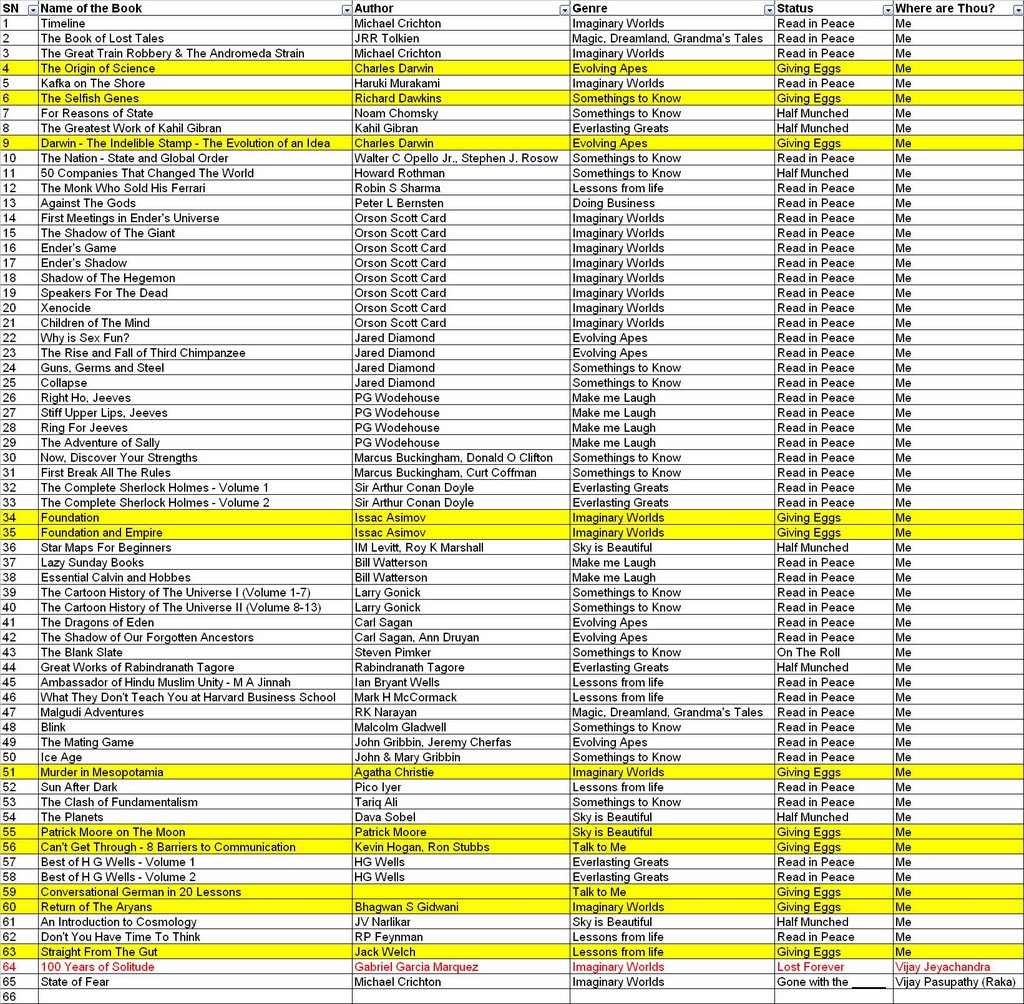 Little bit explaination of notations, I have used:
Genre:
Make me Laugh- Humour, comedy
Somethings to Know- Science, general knowledge or anything interesting to know about
Lessons from life- General life philosophy, biographies, about some person's life, quotes
Imaginary Worlds- Pure fiction, it includes sci-fi
Magic, Dreamland, Grandma's Tales- Fantasy, stories for kids
Everlasting Greats- Classic, it may be fiction, crime, fantasy or poetry, whatever known as great work of literature
Sky is Beautiful- Astronomy, cosmology
Evolving Apes- Anthropology, discussing about human evolution
Numbers Magic- Related to maths
Doing Business- Business related, business history, marketing, strategy
Talk to Me- Communication related, language, etiquettes
Status:
Read in Peace- Have read it
Giving Eggs- Still, not have read
Half Munched- Read it partially, still need to finish
On The Roll- Reading now
Gone with the _____- Lended to someone, with not so bright hopes of getting back soon
Lost Forever- Lended to someone with no hope of return :(
Monday, April 10, 2006
Got it :)
I finally was able get my hands on the selfish genes. Though my body carries innumerous of these but here I am talking about the book 'The Selfish Genes' by Richard Dawkins, which I mentioned in one of my previous post. As a bonus, I also got Feynman Lectures on Physics, all four parts in audio cds.
Though, I will start going through these only after I complete reading the book "Don't you have time to think", by R P Feynman (edited by his daughter, Michelle Feynman). This book is like a break from what all I was reading. This book is a collection of letters written by RP Feynman and if you know RPF's character, these letters contains all his fingerprints. Soem are funny, some serious, some shows an idealist and some shows an emotional being. Collection starts from his college life, letter to mom, his first marriage, atomic bomb, death of wife, death of father, quantum physics, freshman lectures, nobel accolade, then confrontation with authorities. Most fascinating was his comment on love of science, looking a beautiful flower and trying to soak up with nature's little wonder with unfathomable curiosity, wondering and trying to cipher the nature's ways.
Though, I will start going through these only after I complete reading the book "Don't you have time to think", by R P Feynman (edited by his daughter, Michelle Feynman). This book is like a break from what all I was reading. This book is a collection of letters written by RP Feynman and if you know RPF's character, these letters contains all his fingerprints. Soem are funny, some serious, some shows an idealist and some shows an emotional being. Collection starts from his college life, letter to mom, his first marriage, atomic bomb, death of wife, death of father, quantum physics, freshman lectures, nobel accolade, then confrontation with authorities. Most fascinating was his comment on love of science, looking a beautiful flower and trying to soak up with nature's little wonder with unfathomable curiosity, wondering and trying to cipher the nature's ways.
Wednesday, April 05, 2006
Arctic fossils mark move to land
This news was really as part of showing complete progress of fishes evolving in to land animals.
Fossil animals found in Arctic Canada provide a snapshot of fish evolving into land animals, scientists say.
The finds are giving researchers a fascinating insight into this key stage in the evolution of life on Earth.
US palaeontologists have published details of the fossil "missing links" in the prestigious journal Nature.
The 383 million-year-old specimens are described as crocodile-like animals with fins instead of limbs that probably lived in shallow water.
More details here. More links to this story, TIME, Nature, Guardian & NYT.
Thursday, March 30, 2006
'The Selfish Genes'
Just read about this book, 'The Selfish Genes' by Richard Dawkins. Now, I have to find it and read it fast. This is just for keep on reminding me about this book.
Tuesday, March 21, 2006
Here, came the conquerors
Agriculture was accompanied by domestication of animals. Animals helped, not only in ploughing but also provided milk, wool, skin and other products which were treated by early humans as luxury. It can be argued that domestication of milk giving animals preceded agriculture as there is no clear differentiation. But this can be pointed out that domestication of milk giving animals started in the areas where agriculture was tough or non-existent. Animals were already been domesticated for their meat but as humans realized that they can also get milk from these animals, they started keeping these animals at one place. Pigs and fowls were the first animals to be domesticated for meat. Goats followed with cows and buffalos. Horses, camels and elephants were late entrants. But before all these, dogs were the first animals which were domesticated for help in hunting. Dogs were the natural partners to humans as hunter. Cats and other pet animals became habitual to living with humans very late. Cats, as one of the best hunters, initially scarred humans as they were competitors in hunting and became part of many legends. Other animals also had their share of mystrey. Small cats became as for their stealthy nature were good at stealing food from human storages. Initial food storage also faces the problems of rats and small pests. It is argued that agriculture evolved rapidly only when humans had discovered to store grains in closed tanks or containers.
Domestication of horses was one of the biggest factors which transformed early human society completely. Before horses, human were dependent on only their legs for transportation. As for biological constraints, it limited human group's movements and thus limited interactions between different societies. In the circumstances, most of the human societies developed independently and had completely distinct beliefs, customs, social structure and culture. Competitions between adjoining societies were common but this struggle never spread to a particular region, limited by geographical boundaries. Natural habitat for horses is grass plains and they lived in herds. Humans most probably also used to hunt them but might have soon realized that they could also ride them. Domestication of horses had taken a long time as these animals are not so tame like pigs or cows. Also, riding a horse requires certain skills which also had taken a long time to develop. Once the humans were on top of horses, they started spreading rapidly. First human society which domesticated horses is known as 'Aryans'.
Aryans were mainly hunters and used to have huge herds of cows with them for food. Cow was considered sacred as they used to drink cow's milk which was compared to mother's milk. They used to do their most of the property transaction in means of either cows or horses. They were wanderers and kept moving. As being good hunters, they were also great warriors. With the added advantage of fast riding horses, 'Aryans' dominated most of the other societies whom they came in contact. At the time of 'Aryans', agriculture had transformed other societies and there were many human settlements. Aryans in their ride trounced these societies and destroyed their settlement. Commonalities between most of the languages of Asia and
Subscribe to:
Posts (Atom)